Raku Books / Creating a Compiler in Raku / Building AST
AST for expressions
Consider a simple program:
my a;
a = 2 + 3;
The first line is a variable declaration, the second is an assignment. There is one more action here: addition, which also has to be represented by an AST node. Let us build the following tree:
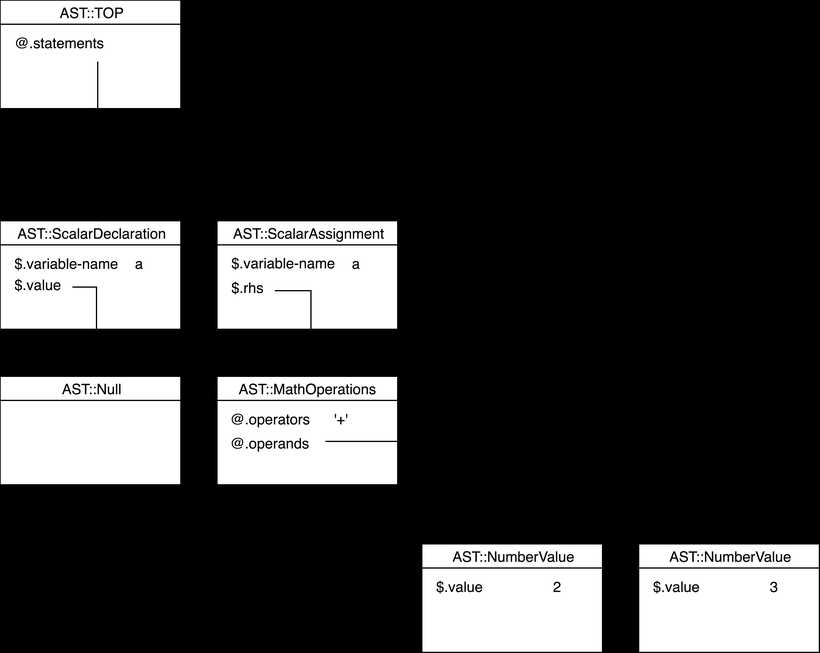
As you may notice, the new node is called
AST::MathOperations and it contains two arrays, for
operators and operands.
In the simplest example, there will be only one operator and two operands, but the same object is also suitable for longer sequences, say , where all operators have the same precedence level. This solution helps to reduce the number of the AST nodes and also simplifies the tree walk on the next stage.
So, here’s the class:
class AST::MathOperations is ASTNode {
    has Str @.operators;
    has ASTNode @.operands;
}
The operators are stored as strings; the operands are other AST
nodes. Embedding AST generation to the LinguaActions class
has more deletions than insertions. We have to remove all the
operation subroutines. They do actual addition,
multiplication, etc., and we do not need that in the AST. All those real
actions will be done on a later stage of traversing the tree.
The philosophy of having a few multi-variants of the
expr action, on one side, makes the implementation more
difficult, as you have to think how the AST node will be propagating to
the top. On the other side, you can split it into even smaller actions
and decide whether you have to emit an AST::MathOperations
or an AST::NumberValue depending on the presence of the
$<op> key in the match object. In other words, if
there are operators in the expression, use
AST::MathOperations, otherwise, it generates a number
stored in the attribute of an AST::NumberValue node.
multi method expr($/ where $<expr> && !$<op>) {
    $/.make($<expr>[0].made);
}

multi method expr($/ where $<expr> && $<op>) {
    $/.make(AST::MathOperations.new(
        operators => ($<op>.map: ~*),
        operands => ($<expr>.map: *.made)
    ));
}

multi method expr($/ where $<expression>) {
    $/.make($<expression>.made);
}
Our implementation is not a standard AST tree for arithmetical expressions. Let us examine a simple expression with operators of different precedence:
my x = 2 + 3 * 4 / 5 - 6;In other books on compiler design and parsing, you would most likely meet a tree where each node represents a single arithmetical operation with two operands, such as shown on the left on the diagram below.
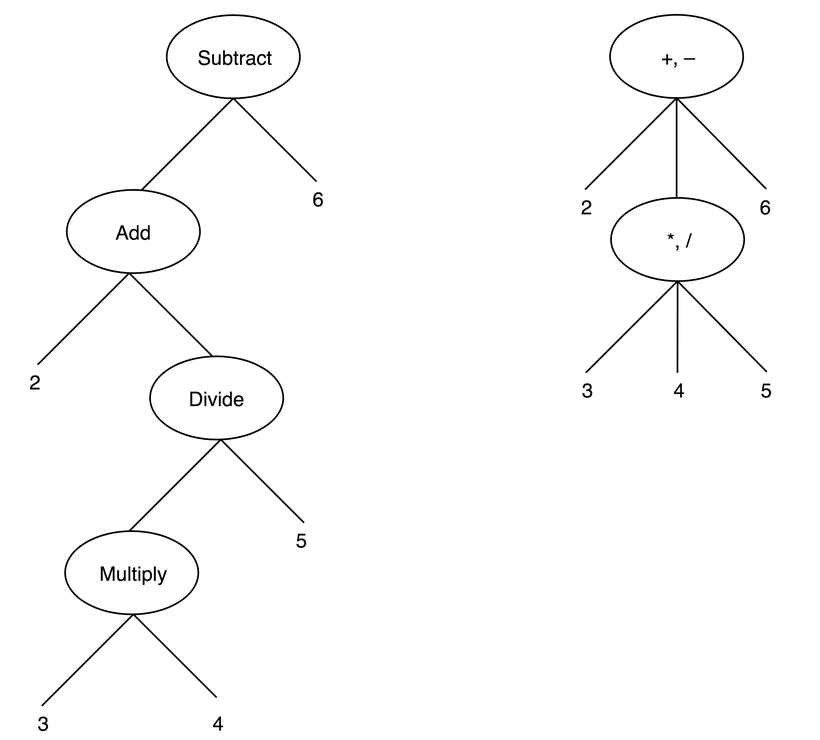
The tree for our compiler is shown on the right. Each node can take any number of operands, and the tree is much more compact: in this example, there are two times fewer nodes comparing to the left version. If the node has three operands, it should always have two operators, which you will later put between the operands.
After the tree is built, the $top variable in the
TOP method will contain the following data structure:
AST::TOP $top = AST::TOP.new(
  statements => Array[ASTNode].new(
    AST::ScalarDeclaration.new(
      variable-name => "x",
      value => AST::MathOperations.new(
        operators => Array[Str].new(
          "+",
          "-"
        ),
        operands => Array[ASTNode].new(
          AST::NumberValue.new(
            value => 2
          ),
          AST::MathOperations.new(
            operators => Array[Str].new(
              "*",
              "/"
            ),
            operands => Array[ASTNode].new(
              AST::NumberValue.new(
                value => 3
              ),
              AST::NumberValue.new(
                value => 4
              ),
              AST::NumberValue.new(
                value => 5
              )
            )
          ),
          AST::NumberValue.new(
            value => 6
          )
        )
      )
    )
  )
)
Course navigation
← Array and hash assignment and initialisation | Function calls →